Halloween Costume ideas 2015

Digital archives contain as usually understood by professional archivists and historians.

Articles by "Arctic"
2009 accessibility Aconcagua Administration Adventure Racing Adventure Travel Adventurists Advice Afghanistan Africa Alaska Alberto Contador Aleutian Islands Alex Honnold Alps Amazon Amherst Amherst Destinations Amherst Hikes Andes Android 1.5 Android 1.6 Android 2.0 Android 2.1 Android 2.2 Android 2.3 Android 2.3.3 Android 3.0 Android 3.2 Android 4.0 Android Design Android Developer Challenge Android Developer Phone Android Market Animals Animation and Graphics Annapurna Announcements Antarctic App Components App Resources Apps Archeology Arctic Arctic Ocean Argentina Art Asia Atacama Desert Atlantic Ocean August Australia Authentication Autumn Aviation Backpacking Backyard Nature Badwater Ultra Baffin Island Baltic Sea BASE Jumping Beach Belchertown Belchertown Destinations Belchertown Hikes Berkshires Best Practices Bhutan Blogging Tips Blogs Book Review Boots Boston Botswana Brazil Broad Peak California Camping Canada Canyoneering Carstensz Pyramid Catatan Puspitasari Central America Central Massachusetts Checkpoint Tracker Children Chile China Cho Oyu Cinta Wanita Circumnavigation Clay Climate Change Climbing Clothing Code Day Colorado Colrain Congo River Connecticut Connectivity Conservation Area Contests Cool Stuff Craft Cycling Dashboard Dave Cornthwaite Death Valley Debugging Denali Developer Console Developer Days Developer Labs Developer profiles Dhaulagiri Dinosaurs Discovery Channel Dolomites Earth Day Easter Island Easthampton Ed Viesturs Educational Eiger El Capitan Endurance Sports Environmental Erving Europe Events Everest Expedition Exploration Explorers Club Fair Fairy House Farm Film Festival Finland Fireworks Fish Hatchery Fitz Roy Food Fourth of July France Free Games Gasherbrum Gaya Hidup Wanita Gear General Adventure Gestures Giro d'Italia Gobi Desert Google I/O Google Play Google Play services Goshen GPS Granby Grand Canyon Greater Boston Greenland Grossology Exhibit Guidelines Hadley Hadley 350th Half Dome Hang Gliding Hawaii Health Hikes Under One Mile Hiking Himalaya History Holyoke Honduras Horse How-to Hubungan Hunting Ice Cream IME impossible2Possible Independence Day India Indoor info Info Seminar Input methods Intents Internet Interview io2010 Italy Japan JNI John Muir Trail Jordan July June Jungfrau K2 K7 Kalahari Kangchenjunga Karakoram Kayaking Kilimanjaro Lake Michigan Lance Armstrong Layout Leadville 100 Leverett Lhotse Libraries Lintas Peristiwa Location Location and Sensors London Long Riders Ludlow Maine Makalu Manaslu Maple Massachusetts Matterhorn Media and Camera Mendon Meru Peak Mexico Mini Golf Mississippi River Missouri River Mongolia Monson Mont Blanc Motivasi Mount Elbrus Mount Everest Mount Rainier Mountain Biking Mountain View Mountaineering Movies Mt. Shasta Munich Museums Music Nameless Tower Namibia Nanga Parbat NASA National Geographic Nature Navigation NDK Nepal New Hampshire New Zealand Newburyport North America North Pole Northampton Northfield Norway Novelet Nuptse Nusantara Nutrition Ocean Okavango Delta Olympics Open source OpenGL ES Optimization Oregon Orizaba Outdoor Outdoor Retailer Outside Magazine Pacific Ocean Packs Paddling Pakistan Palmer Panduan SEO Parade Paragliding Patagonia Pelham Peru Petting Zoo Photography Playground Plum Island Poland Pool Pottery Pumpkins Quabbin Reservoir Quality Quick Search Box Rafting Rahasia Wanita Ray Zahab Reggio Emilia Research Resources Review Road Rally Rowing Roz Savage Running Sailing Sample code Sandbox School Science Scuba Diving SDK updates Sensors September Seven Summits Shelburne Falls Shisha Pangma Shutesbury Silk Road Site News Skateboarding skiing Skydiving Slacklining Sleeping Bags Snowboarding Solstice South Africa South America South Deerfield South Georgia South Hadley South Natick South Pacific South Pole Southern Ocean Space Speech Input Springfield Stand Up Paddling Storytime Strawberries Sturbridge Summer Summer Camp Summit Sunderland Survival Sutton Swimming Switzerland Tanzania Technology Tel Aviv Tents Testing Teva Mountain Games Text and Input Text-to-Speech Thrifty Tibet Torres Del Paine Touch Tour d'Afrique Tour de France Tour Divide Tower Trail Running Train Trango Towers TransRockies Travel Trekking Triathlon Turkey Turner's Falls Tutorial Ueli Steck Ultra Running Ultramarathon UMass United States USA Pro Cycling Challenge User Interface Utah Vancouver Vermont Video Wadi Rum Wakhan Wanita dan Bisnis Water Websites Western Massachusetts Westhampton Widgets Wildlife Williamstown Wingsuits Winter Wisconsin Worcester World Championship Wyoming Yemen Yosemite Zoo

Earlier this week the big news surrounding polar exploration was the announcement that Sir Ranulph Fiennes would be attempting a South Pole expedition in the dead of winter, something that has never been accomplished before. But it seems Fiennes isn't the only Brit set to leave his mark on polar history next year, ultra-runner Tim Williamson has announced plans to make a solo and unsupported round-trip journey to and from the North Pole. Considered by many to be the last great polar adventure that to be completed.

Describing Tim's adventure as a round trip to the North Pole and back simply doesn't do it justice. He has so much more than that planned. The entire journey is expected to cover approximately 2200 miles (3540 km) beginning and ending in civilization. That means he doesn't plan to charter a plane to fly him out to a starting point, but will instead embark on January 13, 2013 directly from Resolute Bay in Canada. Tim expect to return to Resolute just 100-120 days later, which is an incredibly fast time. Even more impressive, he plans on completing the expedition without the use of skis.

In a press release I received earlier in the day Tim is quoted as saying "The majority fail because they aren’t built for walking long distances. This is the thing I’m specially built for. The North Pole holds a great amount of wonder to me, and as an ultrarunner, it is the ultimate challenge."

For anyone who understand the logistics of travel in the Arctic and the herculean task of getting to the North Pole, this will be one epic journey to watch unfold. Traveling across the ice and snow without skis, while dragging all of his gear, food and supplies behind him on a sledge is not going to be easy, even for an endurance athlete. Add to the fact that he's going in the dead of winter, when there is no daylight, and you begin to get a sense of challenges that Tim will face. But the extreme cold at that time of the year will also help to keep the pack ice in place and he could possibly face fewer open leads of water along the way.

I've said more than once in the past few years that the days of traveling to the North Pole on foot may be coming to an end soon. Climate change is making that a very dicey proposition to say the least. It'll be interesting to see an ultra-fit and fast runner give it a go early next year, as Tim's approach is certainly a unique one. I'd hasten to bet he's doing it on a budget that is fraction of what Sir Ran is using to go to the South Pole and back. One thing is for sure, 2013 is going to be an interesting year for polar explorers.

Tim's expedition will be coordinated through DiscoverALifeLessOrdinary.com, in conjunction with Chillisauce.co.uk/.

Following yesterday's announcement that Sir Ranulph Fiennes would be attempting an Antarctic journey to the South Pole in the dead of winter, the BBC today asks what other adventures remain undone? The article laments the fact that satellite imaging and communications technology have taken some of the mystery out of exploration and that in the 21st century most of the remote places of our planet have been visited. Still, they do manage to come up with a list of adventures that have yet to be accomplished.

Some of the suggestions include a climb up Gangkhar Puensum in Bhutan. That 7570 meter (24,835 ft) peak holds the distinction of being the tallest unclimbed mountain in the world. The problem is, climbing ins forbidden on that mountain as the people of Bhutan see it as sacred. The BBC does suggest looking for unclimbed peaks in western China and Tibet however, where plenty of first ascents can still be made. They also note that K2, Makalu and Kangchenjunga have never been skied, although I'd say climbing K2 in winter should sit high on the list of big adventures yet to be done.

The BBC suggests that no one has gone to the North Pole in the dead of winter, but to that I'd say they are wrong. Back in 2006, Mike Horn and Borge Ousland made that journey on foot and without support. It is my belief (as well as that of some polar explorers that I've spoken to) that a trek to the North Pole will become increasingly rare in the years ahead as climate changes makes that journey a more difficult proposition.

According to the article, there are a number of "firsts" that can still be accomplished for the adventurous swimmer. For example, no one has completed a swim across the Pacific, although Ben Lecomte is planning on giving it a try. They also list the Straits of Hormuz, Gulf of Aqaba and Le Perouse Strait as all looking for their first swim as well. Perhaps the ocean depths are the next big area for exploration, as much of those areas have yet to be mapped. That requires a great deal of preparation, technology and planning and is not unlike traveling into space.

I thought this was an interesting article although I am of the mind that there are still plenty of adventurous things to do out int his wide world that we live on. The problem is, there is a perception amongst many that unless you're taking on the tallest or largest target, it really isn't that impressive. With that I definitely disagree. Besides, adventure is a very personal thing and it means something different to all of us. Finding our own adventures are what really matters.

Later this year the producers of the amazing (yet haunting!) The Cove, will release a new film that takes a hard look at climate change and the way our planet is being undeniably altered. Those changes are evident most specifically in the polar ice caps and glaciers of the planet, which are vanishing at an alarming rate. The new film is entitled Chasing Ice and tells the story of National Geographic photographer James Balog, a climate change skeptic who went on assignment to the Arctic in 2005 and  returned with a completely different view. Since then, Balog has made it his mission to chronicle the vanishing ice on our planet and spread the word to others.

The trailer for the new film can be found below and it looks like it is going to be a real eye opener for those who are still on the fence as to whether or not climate change exists and what effect it is having on our world. There are some incredibly powerful images in the trailer itself and I'm looking forward to seeing the full film down the line.


One of the big adventures we've been following this summer is the Arctic Row 2012, during which Paul Ridley, Collin West, Neal Mueller and Scott Mortensen were attempting to travel from Inuvik, Canada to Provideniya, Russia by rowboat. This was to be the first crossing, of sorts, of the Arctic Ocean by a rowing team, but bad weather conditions have conspired agains the crew, forcing them to call off the expedition altogether.

The journey was originally expected to cover some 2100km (1300 miles) and take approximately 30 days to complete. When they set out back in mid-July conditions were actually better than expected and  progress was good. But as the days rolled on things took a turn for the worse and unusually powerful storms began to develop in the Arctic. Those storms proved to be impossible to row in, which slowed progress to a crawl. On more than one occasion, the team had to take shelter in a lagoon, sometimes for days, in order to wait out the heavy seas and high winds that were blowing through their area.

The delays proved costly and a journey that was expected to take about a month began to drag on much further. Today was their 41st day at sea and with their supplies dwindling and more storms on the horizon, they decided to go ashore at Point Hope, Alaska.

In a lengthy blog post last night the team talked about the trials and tribulations of their voyage. It hasn't been an easy one to say the least and for four men who have been stuck inside the tiny cabin of a small ocean rowboat, I'm sure it felt good to come ashore yesterday.

I'm sure we'll hear more about their story in the days ahead, as for now they are likely eating and catching up on their rest. It was a valiant attempt on their part, but the Arctic Ocean proved a bit too strong for these men. At least for now.

The last time we checked in with the Arctic Row team they were waiting out a storm in a relatively calm inlet on the Arctic Ocean. At that point, the four member crew was preparing to get back underway, after having just passed their half-way point. Forward progress didn't last very long however, as another storm blew into the area a few days later and as a result the boys have not advanced nearly as far as they would have liked.

The Arctic Row actually began on back on July 17 with the plan of rowing from Inuvik, Canada to Provideniya, Russia, a distance of 2100km (1300 miles). They had originally estimated that it would take approximately 30 days to complete the journey, but as it stands right now they're hoping to reach Point Hope, Alaska sometime today. That's a good milestone for the crew, but it also means they have a lot more miles to row before they reach their destination.

To make matters worse, the boat's water-maker, a device used by ocean rowers to desalinate ocean water and make it drinkable, is causing them problems. Their latest update indicates that it is they do have a second water-maker, although it is a hand-pump model which can work as a back-up should the primary unit fail completely.

The big question now is is the boat stocked with enough food and supplies for the row to continue all the way to Russia. They've already shot past their 30 day window and are now on borrowed time. It would be one thing if they were just a few days away from the finish line, but they are potentially facing a couple of more weeks out on the water. If another major storm pops up, and the storms this season have been horrible, they could find themselves in a nasty situation. Worse yet, they will soon leave land behind completely and set out to open sea.

Stay tuned!

It has been a very long and tough week for the Arctic Row team. The four-man crew set out a few weeks back in an effort to cross the Arctic Ocean in a rowboat starting at Inuvik, Canada and ending in Providenya, Russia, a distance of about 1300 miles (2092km) that was expected to take 30 days to complete. Now 21 days into the voyage and they aren't even close to wrapping up the trip, thanks in now small part to a massive storm that has hit the arctic and halted progress for the past week.

Early on in the row the team was surprised to find not only good weather but clear water conditions as well. Few icebergs were spotted and winds were calm with warmer than expected temperatures. This allowed them to cover solid mileage as they continued to row non-stop, 24-hours per day in two hour shifts. That pattern allowed them to cross the half-way point of their journey on the first of August, which put them slightly behind schedule but still making good time.

That all changed when they started to hit heavy winds last Friday. Progress slowed to a crawl and levels of exhaustion quickly increased. Those winds eventually started to hit sustained speeds of 45 mph (72 kph), which not only made the seas choppy but also made it nearly impossible to keep moving forward. Then it started to rain. A cold, hard rain that wasn't very conducive for spending long hours behind the oars.

With conditions so poor, the boys decided to seek shelter in a protected lagoon not far from Barrow, Alaska. They managed to limp into the relatively calm waters and drop anchor, and unfortunately they were stuck there until today when they took to the oars once again just to move five miles towards Point Barrow in order to be in position to resume their journey once the storm lets up once and for all. For now though, they continue to wait for improvement.

This massive storm is very unusual for this time of year. Typically July and August are the calmest months of the year in the Arctic Ocean, which is why that is the period of time that these kinds of adventures take place there. A storm of this size and intensity doesn't tent to form in the warmer months, but then again judging from how bad the weather was in the Karakoram this season, I'm beginning to think that all bets are off in terms of long term forecasts.

Hopefully the weather will improve and the crew can continue forward again soon. I'm sure they're well supplied with food and gear, but they still have a long way to go until they're done. Keep your fingers crossed they get through this and get back underway shortly.

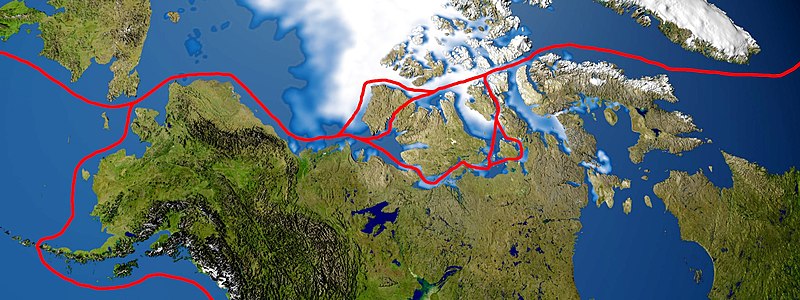
While I was away last week the details of a major expedition, slated to get underway next year, began to emerge. In July of 2013 a team of rowers will attempt to become the first to complete a crossing of the Northwest Passage in a single season, covering roughly 3000km (1864 miles) between Pond Inlet and Tuktoyaktuk, Canada in the process.

Scheduled to get underway July 1st of next year, The Last First expedition is expected to take approximately 75 days to complete. During that time, the crew will row non-stop through some of the most challenging and treacherous waters on the planet, facing unpredictable weather, massive ice flows and frigidly cold waters along the way.

As many of you know, this type of journey wasn't even possible until recently. Changing climatic conditions have caused much of the polar ice cap to melt, opening the Passage to travel for the first time. Even with those changes however the route is only navigable for a few months each year and is still a very difficult crossing. Climate change has had a dramatic effect on the region and the crew, which consists of adventurers Kevin Vallely, Paul Gleeson, Frank Wolf, and Denis Barnett,  will witness those changes first hand as they visit remote communities along the way.

Find out more about The Last First on the expedition's website and in the video below.


The Arctic Row 2012 expedition has now been underway for just over a week and the team continues to make slow, but steady progress – that is when the weather allows. After setting off last Tuesday, the four men aboard the small rowboat have had their ups and downs as they struggle to find their rhythm, but it seems they remain in good spirits and committed to achieving their goal of rowing across the Arctic Ocean.

As you no doubt recall, Paul Ridley, Collin West, Neal Mueller and Scott Mortensen are attempting to row from Inuvik, Canada to Provideniya, Russia, a distance of 2100km (1300 miles). They had planned for the entire journey to take approximately 30 days, as they are rowing 24-hours per day in two hour, two-man shifts. But already in the first week they've had to spend some time on anchor as rough seas and high winds have made progress impossible. Still, their home team reports that they are making the most out of the experience and have enjoyed the expedition thus far.

According to their latest blog update the boys are just now starting to encounter ice. They've come across absolutely massive icebergs that are easily spotted from a distance and they've only seen smaller ones that have broken off from the bigger ones so far. As they progress further along in the expedition they expect to encounter more ice in general, which could slow progress at times too, but for now things are good.

The team's SPOT device hasn't been providing accurate tracking of their progress, so it's difficult to tell how much ground they've covered. Reading through the reports, I'd guess that they aren't on their intended schedule however, so it is already starting to look like the could go past their 30 day window. Of course, they could make up time if the weather cooperates, but we'll just have to wait to see how things unfold.

Either way, they team is just getting started and there is still a lot of rowing to go.

Arctic explorer Lonnie Dupree has an impressive resume. Not only has he crossed the Northwest Passage by dogsled in winter, he has also circumnavigated Greenland, visited the North Pole and attempted Denali solo in the heart of winter – twice! In the video below, Lonnie shares footage from his various cold weather adventures, giving us a glimpse of his life on the ice and the expeditions he has taken to the remote places of the world.


25 Years of Arctic Exploration from Lonnie Dupre on Vimeo.

It's been awhile since we had a new timelapse video that could inspire thoughts of adventure and a feeling of wanderlust. I came across this one earlier today and thought it fit the description quite nicely. Not only is is very well done and the setting is spectacular, but those of us who have been enduring a heat wave over the past few weeks will also enjoy its arctic theme.


Arctic Motion from Tor Even Mathisen on Vimeo.

Norwegian explorers Audun Tholfsen and Timo Palo have completed their arctic adventure at last. The two men, whom I've written about a couple of times throughout their journey, arrived at Longyearbyen a few days ago, closing out a 1600km (994 mile) expedition that took 72 days to finish.

The two men launched their excursion on April 23, starting at 90ºN and heading south towards Svalbard. Using skis and kayaks they crossed vast open areas of ice and ocean, enduring incredibly bad weather, daunting surface conditions and the occasional polar bear while en route.

Audun and Timo estimate that of the 1600 or so kilometers that they covered in their journey about 400km (248 miles) of that was done in a kayak. The rest of the time they were on skis and pulling their gear, including the kayaks, behind them. That's a lot of miles to cover on foot in some of the toughest conditions on the planet.

Now that they've been back for a few days the two men report that they are in good physical condition and recovering nicely from the challenges of the expedition. They say that they've missed hot showers and pizza the most, and I suspect that they are enjoying both right now. They promise to share more information on their adventure once they've had a chance to rest and settle in, so be sure to watch their website for any future updates.

Congrats to both Audun and Timo on a job well done. Those pizzas and hot showers have been well earned mates.

I came across this video a few days ago and thought it was worth sharing. The Arctic is one of those places that inspires thoughts of adventure, but the way things are going, it may not be around for much longer. Global climate change is having a direct impact on the polar ice caps and as a result, our world is changing dramatically. In the video, a displaced polar bear wanders the streets of London, giving us some striking images that are incredibly sad.

The ad was inspired by the Save The Arctic organization, which is an offshoot of Greenpeace.


Way back in November of last year I wrote about a team of rowers who were gearing up to challenge the Arctic Ocean this spring. At the time, they were still looking to add a fourth member to their crew and the expedition was still taking shape. Fast forward a eight months and now they are in the final stages of preparation before setting out in July.

The aptly titled Arctic Row 2012 will put paul Ridley, Collin West, Neal Mueller and Scott Mortensen out on the Arctic Ocean for as much as 30 days. The plan is for the team to set off from Inuvik, Canada and cross the ocean into Providenya, Russia. The route will cover approximately 1300 miles (2092 km) of water that will, at times, be chocked with ice.

In order to cover that distance within a four week time span, the team will be rowing non-stop, 24-hours a day. They'll take two hour shifts with two men rowing at all times while the other two rest. In order to maintain that pace, the crew will eat in excess of 5000 calories per day while onboard desalinators convert up to 400-pounds of salt water into drinking water on a daily basis as well.

The expedition isn't just about making the first crossing of the Arctic Ocean in a row boat, although that is a worthy goal in and of itself. While they're out on the water the team will be making observations about the health of the Arctic ecosystem and will be collecting samples of plankton throughout the region. Those tiny fish are a crucial food supply for the whales that migrate through the area and the health of the plankton population can offer insights into how the entire ecosystem is faring.

Good luck guys!

It has been over a month since I posted an update on the progress of Audun Tholfsen and Timo Palo, the two Norwegian explorers who were dropped off at the North Pole back in April and have been making their way south ever since. The boys have had their struggles over the past weeks, but they continue to make good progress and are slowly, but surely closing in on the finish line at last.

While on their journey, Audun and Timo have traveled by ski and kayak as they make their way towards Longyearbyen, on the island of Svalbard. The entire excursion will cover approximately 1400km (870 miles) once it it completed and will mark the longest and most challenging North Polar expedition of the year by far. As of yesterday the duo were at about 82º30' north latitude, which would put them squarely in the Arctic Ocean. But since the area is still mostly frozen, they continue to use a combinations of skiing and paddling to make progress.

The two explorers have been making periodic updates to their blog in which they share the experiences of their travels. Those experiences have included nasty storms that have lasted for several days, dealing with broken equipment, polar bears, difficult terrain and more. All of those things have made the journey a challenging one, but they are still on track to finish sometime late this month, provided they don't encounter more unexpected challenges.

Its great to see that one of the North Pole expeditions is doing well and continuing forward. It's beginning to look like more expeditions will be starting at 90ºN in the future instead of ending there.

MKRdezign

Contact Form

Name

Email *

Message *

Powered by Blogger.
Javascript DisablePlease Enable Javascript To See All Widget